


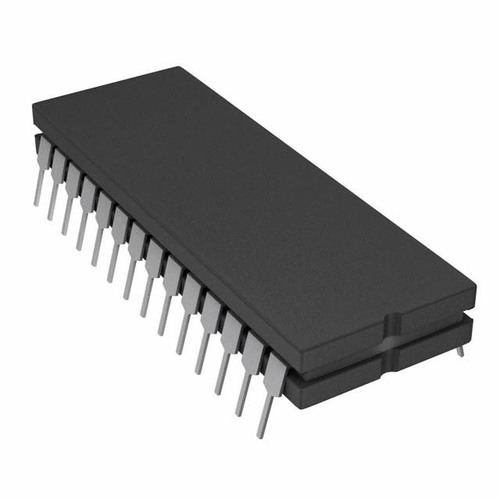
AD7828BQ
500 INR
Product Details:
- Operating Temperature 0C to +70C
- Response Time 2 s (conversion time)
- Output 8-bit digital code
- Interface Parallel
- Thermal Conductivity Standard for DIP ICs
- IP Rating Not Rated
- Features 8 channel input, fast conversion, TTL compatible
- Click to View more
X
AD7828BQ Price And Quantity
- 10 Piece
- 500 INR
- 1 LSB
- 10 s (maximum)
- TTL/CMOS Compatible
- No
- 20 Pins
- 0V to +5V (Analog Input)
- Analog Devices
- Internal and External Reference Available
- Plastic DIP (PDIP)
- AD7828BQ
- 0.5 LSB
AD7828BQ Product Specifications
- 24.2mm x 6.35mm x 3.56mm
- +5V, -5V
- Black
- Typically 3mA
- Parallel
- Standard DIP package
- 8-bit digital code
- Approx. 2g
- 2 s (conversion time)
- 0C to +70C
- Not Rated
- Analog to digital conversion, microprocessor interfacing
- DC to 200 kHz
- Standard for DIP ICs
- AD7828 core, multiplexer, voltage reference
- 8 bit
- 8 channel input, fast conversion, TTL compatible
- External (PCB supplied)
- Analog-to-Digital Converter (ADC)
- Integrated Circuit
- Data acquisition systems
- 5V
- 8 channels, 8 bits
- Standard IC profile
- 8-channel analog multiplexed input
- Dual supply (+5V, -5V)
- 1 LSB
- 10 s (maximum)
- TTL/CMOS Compatible
- No
- 20 Pins
- 0V to +5V (Analog Input)
- Analog Devices
- Internal and External Reference Available
- Plastic DIP (PDIP)
- AD7828BQ
- 0.5 LSB
AD7828BQ Trade Information
- All India
Product Description
Specification
| Architecture | Flash |
| Voltage Supply Digital | 5V |
| Supplier Device Package | 28-CDIP |
| Sampling Rate | 50k (Per Second) |
| Reference Type | External |
| Ratio SH ADC | 11 |
| Part Status | Active |
| Packaging | Tube |
| Package Case | 28-CDIP (0.600", 15.24mm) |
| Operating Temperature | -40 deg C ~ 85 deg C |
| Number of Inputs | 8 |
| Number of AD Converters | 1 |
| Input Type | Single Ended |
| Data Interface | Parallel |
| Configuration | MUX-S/H-ADC |
| Base Part Number | AD7828 |
Fast and Accurate Analog-to-Digital Conversion
With a conversion time as rapid as 10 s (maximum) and a high degree of precision (1 LSB INL), the AD7828BQ excels in environments demanding both speed and accuracy. Its capability to handle 8 separate analog inputs makes it especially effective for multi-channel data acquisition tasks, delivering reliable output across a standard 8-bit resolution.
Versatile Reference and Power Supply Options
The AD7828BQ offers users flexibility with both internal and external voltage references, allowing for adaptable integration within various system architectures. Its power supply requirementsdual +5V and -5Venable robust performance and compatibility with diverse power systems, making it well-suited for general and specialized electronic applications.
Easy Integration and Broad Compatibility
Designed to interface seamlessly with TTL and CMOS logic levels, the AD7828BQ can be directly connected to most microprocessor-controlled systems. Its parallel interface, standard DIP package, and compact size allow for straightforward PCB implementation without the need for complex adaptation circuits.
FAQs of AD7828BQ:
Q: How is the AD7828BQ used in data acquisition systems?
A: The AD7828BQ serves as a multi-channel analog-to-digital converter, capturing and converting up to 8 analog input signals into 8-bit digital outputs quickly. This makes it ideal for data acquisition systems that need to monitor and digitize multiple sensor signals simultaneously.Q: What is the typical process for interfacing the AD7828BQ with a microprocessor?
A: Interfacing involves connecting the ADCs parallel output to the microprocessors data bus. Users select analog channels via address pins and can use either the internal or an external reference. Its TTL/CMOS compatibility ensures straightforward integration into most digital architectures.Q: When should I choose the internal reference versus the external reference option?
A: Use the internal reference for simplicity and space savings when standard accuracy is acceptable. Choose the external reference for greater control and improved precision if your application demands it, such as in high-accuracy data measurement environments.Q: Where can the AD7828BQ be installed for best results?
A: The AD7828BQ is best installed on PCBs in controlled environments with supply voltages of +5V and -5V. It fits standard DIP sockets and works well in laboratory, industrial, or custom instrumentation settings within its 0C to +70C operating temperature range.Q: What are the advantages of the 8-channel multiplexer in the AD7828BQ?
A: The integrated 8-channel multiplexer allows you to connect multiple analog sources with a single ADC, simplifying circuit designs, reducing cost, and enhancing system flexibility without sacrificing conversion speed or accuracy.Q: How does the AD7828BQ benefit microprocessor-based applications?
A: The devices fast conversion time, TTL/CMOS logic compatibility, and parallel interface streamline analog signal capture for microprocessors, improving overall system speed, simplifying signal routing, and providing reliable digital data for further processing.Q: What precautions should I take regarding RoHS compliance with the AD7828BQ?
A: The AD7828BQ is not RoHS compliant, meaning it contains lead or other restricted substances. When using this component, ensure your application does not require lead-free or fully RoHS-compliant parts, especially for export or green manufacturing environments.Tell us about your requirement

Price:
Quantity
Select Unit
- 50
- 100
- 200
- 250
- 500
- 1000+
Additional detail
Mobile number
Email

Other Products in 'Analog Devices IC' category



Contact Details
KK INTERNATIONAL
Mumbai, Maharashtra, India
Mumbai, Maharashtra, India

- Plot No. 305, Rajdeep Apartments, Tara Temple Lane, Near Lamington Road,Mumbai - 400007, Maharashtra, India
- Phone : 08045477473
- Mr Pratik Chouhan (Managing Director)
- Mobile : 08045477473
-
 Send Inquiry
 Send Inquiry
 Send Inquiry
 Send SMS
Quick Inquiry

 |
KK INTERNATIONAL
All Rights Reserved.(Terms of Use) Developed and Managed by Infocom Network Private Limited. |
