


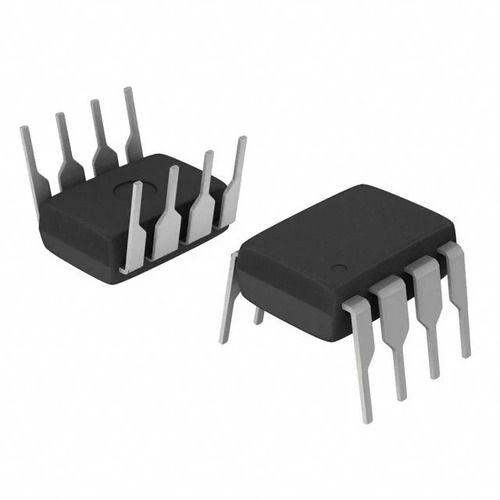
INA106KP
200 INR
Product Details:
- Resolution High precision, Offset voltage: 0.2 mV typ
- Output Analog Output
- Components Monolithic IC
- Features Low Offset Voltage, High Common-Mode Rejection, Unity Gain Difference Amplifier
- Operating Temperature -40C to +85C
- Usage Signal Amplification
- Interface Pin (through-hole)
- Click to View more
X
INA106KP Price And Quantity
- 200 INR
- 10 Piece
- 86 dB typ @ DC
- Through Hole
- Fixed at 1 (Unity Gain)
- Yes
- < 1
- Yes
- Plastic DIP-8
- 100 M (both inputs)
INA106KP Product Specifications
- Low Offset Voltage, High Common-Mode Rejection, Unity Gain Difference Amplifier
- Monolithic IC
- Precision signal processing, Instrumentation, Industrial measurement
- -40C to +85C
- Precision Difference Amplifier
- Approx. 10mm x 7mm x 4mm
- Signal Amplification
- Approx. 1 g (package)
- Black (IC body)
- Analog Output
- High precision, Offset voltage: 0.2 mV typ
- Standard IC Package
- Dual or Single Supply
- External (circuit supplied)
- Differential Analog Input
- Integrated Circuit (Operational Amplifier)
- Maximum 18V
- Quiescent current: 2.3 mA typ
- Bandwidth: 180 kHz
- Pin (through-hole)
- DIP-8 (Dual In-line)
- 4V to 18V
- 86 dB typ @ DC
- Through Hole
- Fixed at 1 (Unity Gain)
- Yes
- < 1
- Yes
- Plastic DIP-8
- 100 M (both inputs)
INA106KP Trade Information
- All India
Product Description
Specification
| Amplifier Type | Differential |
| Mounting Type | Through Hole |
| Voltage Supply Single or Dual | +-5 V ~ 18 V |
| Voltage Input Offset | 50uV |
| Three db Bandwidth | 1MHz |
| Supplier Device Package | 8-PDIP |
| Slew Rate | 3 V/us |
| Part Status | Active |
| Packaging | Tube |
| Package Case | 8-DIP (0.300", 7.62mm) |
| Operating Temperature | 0 deg C ~ 70 deg C |
| Number of Circuits | 1 |
| Current Supply | 1.5mA |
| Current Output Channel | 20mA |
| Base Part Number | INA106 |
High-Performance Signal Amplification
With outstanding common-mode rejection and high input impedance, the INA106KP excels at amplifying differential analog signals while minimizing interference. Its fixed unity gain ensures linear, high-fidelity reproduction, making it ideal for critical signal processing tasks in industrial, medical, or scientific equipment.
Versatile, Reliable Package
The sturdy DIP-8 package offers ease of mounting and compatibility with standard PCB layouts. At just 1 gram and with compact dimensions (10mm x 7mm x 4mm), the INA106KP integrates seamlessly into space-constrained designs while maintaining robust electrical performance in varied environments.
Precision for Demanding Applications
Engineered for applications up to 18V operation and a wide temperature range (-40C to 85C), the INA106KP supports high-precision instrumentation and measurement in both laboratory and industrial settings. Its low offset and high resolution ensure reliable signal comparison even at minute voltage differences.
FAQs of INA106KP:
Q: How is the INA106KP typically used in signal processing applications?
A: The INA106KP serves as a precision difference amplifier, ideal for amplifying low-level differential signals in instrumentation and industrial measurement systems, ensuring accurate signal comparison and suppression of common-mode noise.Q: What benefits does the high common-mode rejection ratio (CMRR) of 86 dB provide?
A: A CMRR of 86 dB means the INA106KP effectively rejects interference from common signals on both inputs, minimizing error and enhancing accuracy in environments with electrical noise.Q: When should I consider using a unity gain difference amplifier like the INA106KP?
A: Deploy the INA106KP when your application requires precise voltage difference measurement without additional gain, such as analog front-end circuits for sensors, data acquisition, and process control.Q: Where can the INA106KP be mounted and used?
A: The INA106KP is designed for through-hole mounting on standard PCBs, suitable for laboratory instruments, industrial automation systems, and applications across India through distributors, importers, or manufacturers.Q: What process should be followed to integrate the INA106KP into a circuit?
A: Integrate the INA106KP by soldering the DIP-8 package to the PCB, applying differential analog input signals, and configuring the power supply within 4V to 18V, ensuring correct pin connections for optimal performance.Q: How does the INA106KP achieve high input impedance?
A: The INA106KP utilizes internal monolithic IC circuitry to provide an input impedance of 100 M on both inputs, allowing it to interface with high-impedance sources without loading them or affecting measurement accuracy.Q: What are the advantages of the INA106KP being RoHS compliant and lead-free?
A: RoHS compliance and a lead-free design make the INA106KP environmentally friendly and safe for use in restricted or regulated environments, ensuring adherence to global manufacturing standards.Tell us about your requirement

Price:
Quantity
Select Unit
- 50
- 100
- 200
- 250
- 500
- 1000+
Additional detail
Mobile number
Email

Other Products in 'Burr - Brown ICs' category



Contact Details
KK INTERNATIONAL
Mumbai, Maharashtra, India
Mumbai, Maharashtra, India

- Plot No. 305, Rajdeep Apartments, Tara Temple Lane, Near Lamington Road,Mumbai - 400007, Maharashtra, India
- Phone : 08045477473
- Mr Pratik Chouhan (Managing Director)
- Mobile : 08045477473
-
 Send Inquiry
 Send Inquiry
 Send Inquiry
 Send SMS
Quick Inquiry

 |
KK INTERNATIONAL
All Rights Reserved.(Terms of Use) Developed and Managed by Infocom Network Private Limited. |
