


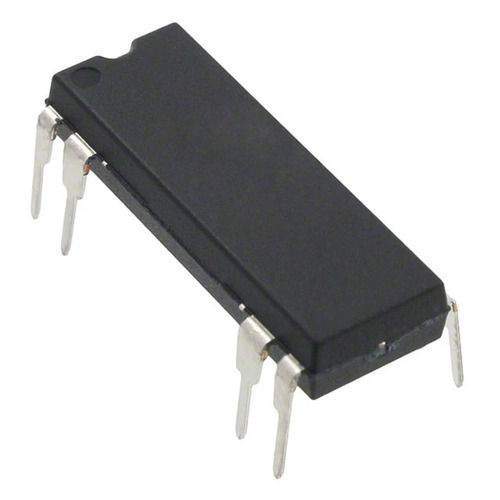
ISO122JP
650 INR
Product Details:
- Sensors Specification --
- Thermal Conductivity --
- Operating Temperature 0C to +70C
- Charging Voltage --
- Components ISO122JP Chip
- Output Analog Differential
- Response Time --
- Click to View more
X
ISO122JP Price And Quantity
- 650 INR
- 10 Piece
- 1500 Vdc
- Through Hole
- DIP-8 (Dual In-line)
- Yes
- Single Ended/Differential
- Yes
- > 1 G
- 0.05% (max)
- 140 dB (typical)
ISO122JP Product Specifications
- Analog Differential
- External
- --
- --
- 18 V
- Precision Isolation Amplifier
- Low Offset Voltage, High Linearity, Galvanic Isolation
- Standard IC Package
- Black
- --
- DIP-8
- 50 kHz Bandwidth
- 10.16 x 6.35 x 3.30 mm
- Signal Isolation
- Optoelectronic Coupler IC
- 1.3 mA (typical, per amplifier)
- Dual, 4 V to 18 V
- 0.4 g (approx)
- --
- Analog
- 4 V to 18 V
- 0C to +70C
- --
- --
- Industrial, Medical, Data Acquisition
- --
- Analog Differential
- ISO122JP Chip
- --
- --
- 1500 Vdc
- Through Hole
- DIP-8 (Dual In-line)
- Yes
- Single Ended/Differential
- Yes
- > 1 G
- 0.05% (max)
- 140 dB (typical)
ISO122JP Trade Information
- All India
Product Description
Specification
| Amplifier Type | Isolation |
| Mounting Type | Through Hole |
| Voltage Supply Single or Dual | +-4.5 V ~ 18 V |
| Voltage Input Offset | 20mV |
| Three db Bandwidth | 50kHz |
| Supplier Device Package | 16-PDIP |
| Slew Rate | 2 V/us |
| Part Status | Active |
| Packaging | Tube |
| Package Case | 16-DIP (0.300",7.62mm),8 Leads |
| Operating Temperature | -25 deg C ~ 85 deg C |
| Number of Circuits | 1 |
| Current Supply | 5mA |
| Current Output Channel | 15mA |
| Base Part Number | ISO122 |
Superior Galvanic Isolation and Signal Integrity
The ISO122JP offers industry-leading galvanic isolation of up to 1500 VDC, safeguarding sensitive measurement electronics from high voltages and ground loops. This capability, combined with a typical Common Mode Rejection Ratio (CMRR) of 140 dB, makes it perfect for demanding environments where signal accuracy and integrity are paramount.
Versatile Application Coverage
Designed for versatility, the ISO122JP suits a wide range of fields including industrial automation, medical instrumentation, and precision data acquisition. Its high input impedance and low offset voltage guarantee accurate transmission of analog differential signals, supporting reliable system performance across diverse sectors.
Effortless Integration and Compliance
Thanks to its standard DIP-8 package and through-hole mounting, the ISO122JP integrates seamlessly into existing hardware. The device is RoHS-compliant and lead-free, aligning with modern environmental and safety standards. It suits both new designs and legacy system upgrades, providing reliable, environmentally friendly signal isolation.
FAQs of ISO122JP:
Q: How does the ISO122JP enhance signal isolation in my application?
A: The ISO122JP provides galvanic isolation up to 1500 VDC and achieves a 140 dB typical CMRR, effectively preventing noise, voltage spikes, and ground loop issues from degrading the quality of analog differential signals in industrial or medical environments.Q: What types of signals can be processed using the ISO122JP?
A: This amplifier is designed for analog differential input and output signals, offering precise signal isolation for critical measurement, control, and data acquisition tasks.Q: When should I consider using the ISO122JP in my system design?
A: Use the ISO122JP when your application requires high-accuracy signal transmission across isolated grounds or safety barriers, particularly in settings where system reliability and operator safety are essential, such as industrial process control or patient monitoring equipment.Q: Where can the ISO122JP be installed in existing hardware?
A: With its DIP-8 package and through-hole mounting, the ISO122JP can be conveniently implemented into standard circuit boards for industrial, medical, or laboratory instrumentation. It fits compactly into spaces demanding robust isolation and high linearity.Q: What is the process for integrating the ISO122JP into my PCB?
A: To integrate, insert the DIP-8 package into the appropriate socket or plated through-holes, connect the dual 4 V to 18 V supply voltages, and route your analog differential input and output channels accordingly. Ensure compliance with recommended layout practices for isolation amplifiers.Q: How does the ISO122JP benefit industrial or medical applications?
A: It provides precise signal isolation, low offset voltage, and exceptional linearity, bolstering accuracy in measurements, safeguarding equipment, and ensuring safety for users where hazardous voltages or interference might otherwise threaten system performance.Tell us about your requirement

Price:
Quantity
Select Unit
- 50
- 100
- 200
- 250
- 500
- 1000+
Additional detail
Mobile number
Email

Other Products in 'Burr - Brown ICs' category


Contact Details
KK INTERNATIONAL
Mumbai, Maharashtra, India
Mumbai, Maharashtra, India

- Plot No. 305, Rajdeep Apartments, Tara Temple Lane, Near Lamington Road,Mumbai - 400007, Maharashtra, India
- Phone : 08045477473
- Mr Pratik Chouhan (Managing Director)
- Mobile : 08045477473
-
 Send Inquiry
 Send Inquiry
 Send Inquiry
 Send SMS
Quick Inquiry

 |
KK INTERNATIONAL
All Rights Reserved.(Terms of Use) Developed and Managed by Infocom Network Private Limited. |
