


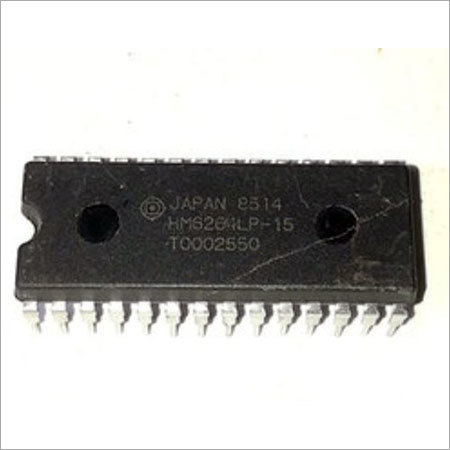
SRAM IC
100 INR
Product Details:
- Output Digital data output
- Input Digital address, control, and data signals
- IP Rating Not rated for ingress protection
- Features High speed, non-volatile storage, low power dissipation, random access read/write.
- Usage Memory storage in electronics, microcontrollers, embedded systems, and digital devices.
- Power Supply DC
- Interface Parallel interface (standard DIL or SMD pins)
- Click to View more
X
SRAM IC Price And Quantity
- 100 INR
- 10 Piece
- 8-bit, 16-bit, or 32-bit (depending on specific IC)
- Through Hole (DIP) / Surface Mount (SMD)
- DIP (Dual In-line Package) / SMD (Surface Mount Device) - varies by IC model
- -65°C to +150°C
- Typically 24 to 32 pins (model-dependent)
- 2.54 mm (DIP), 1.27 mm (SMD, varies by package)
- 2V minimum
- Yes, RoHS compliant
- Compliant with JEDEC standard
SRAM IC Product Specifications
- Semiconductor memory cells, plastic encapsulated package, metal leads
- Up to 100 MHz (depends on model)
- Parallel interface (standard DIL or SMD pins)
- Access time: 55 ns to 120 ns (model-dependent)
- External DC supply
- Standard DIP/SMT IC package (depends on model)
- Approximately 3 grams
- Static Random Access Memory (SRAM) integrated circuit designed for high-speed data storage and retrieval.
- Approx. 19 mm x 6 mm x 2 mm
- 4.5V to 5.5V
- -40C to +85C
- Electronic circuits, microprocessors, FPGA, cache memory, industrial control systems
- SRAM Memory IC
- Typically ranges from 2 Kb to 512 Kb (model-dependent)
- Digital data output
- Digital address, control, and data signals
- High speed, non-volatile storage, low power dissipation, random access read/write.
- Black (Chip body), Silver (Leads)
- Not rated for ingress protection
- Average Operating Current: 20-40 mA
- 5V DC (typical)
- Memory storage in electronics, microcontrollers, embedded systems, and digital devices.
- Approx. 2 mm (body thickness)
- DC
- 8-bit, 16-bit, or 32-bit (depending on specific IC)
- Through Hole (DIP) / Surface Mount (SMD)
- DIP (Dual In-line Package) / SMD (Surface Mount Device) - varies by IC model
- -65°C to +150°C
- Typically 24 to 32 pins (model-dependent)
- 2.54 mm (DIP), 1.27 mm (SMD, varies by package)
- 2V minimum
- Yes, RoHS compliant
- Compliant with JEDEC standard
SRAM IC Trade Information
- All India
Product Description
We are emerging as one of the fastest growing companies engaged in supplying SRAM IC. It is random access memory that retains data bits in its memory as long as power is being supplied. We source this component from the trusted and reputed vendors of the market. It provides faster access to data and is more expensive than DRAM. SRAM IC is used for a computers cache memory and as part of the random access memory digital-to-analog converter on a video card.
Features:
- 8-pin low-power, high-performance component
- High operating temperature
- Easy to mount
Versatile Mounting Options
SRAM ICs are available in both Dual In-line Package (DIP) and Surface Mount Device (SMD) variants, supporting through-hole and surface mounting technologies. This flexibility allows seamless integration into traditional PCBs as well as compact, modern designs requiring higher packaging density.
High-Speed and Reliable Performance
These memory chips operate at frequencies up to 100 MHz, with access times ranging from 55 ns to 120 ns depending on the model. They offer robust data retention with a minimum 2V hold, ensuring data security during power interruptions, and support 8-bit, 16-bit, or 32-bit data bus widths for a variety of applications.
Compliance and Safety Assurance
The SRAM ICs meet JEDEC industry standards and are RoHS compliant, ensuring safe, environmentally friendly use. Their buildblack chip body with silver leadsincludes reliable semiconductor memory cells and encapsulation for durable operation in harsh conditions.
FAQs of SRAM IC:
Q: How do I choose between the DIP and SMD package types for my SRAM IC application?
A: Select a DIP package for easy prototyping or through-hole PCB designs, which are ideal for manual assembly and testing. Choose an SMD package when compact size and automated surface mounting are required, suitable for high-volume or space-constrained designs.Q: What are the primary benefits of using SRAM ICs in electronic circuits?
A: SRAM ICs offer fast, random-access data storage and retrieval, low power consumption, non-volatile operation with data retention at 2V minimum, and compatibility with standard microcontrollers, FPGAs, and embedded systems. They are perfect for cache memory, industrial control, and high-speed applications.Q: When should I consider a specific data bus width (8, 16, or 32-bit) for my design?
A: The appropriate data bus width depends on your systems data handling requirements. Use an 8-bit bus for simple applications, shift to 16- or 32-bit widths for increased data throughput or compatibility with complex processors and high-performance embedded solutions.Q: Where are these SRAM ICs typically used in industry?
A: These SRAM ICs are commonly employed in electronic circuits, microprocessors, FPGAs, cache memory modules, and industrial control systems. Their use spans consumer electronics, automation equipment, and embedded devices requiring fast and reliable memory.Q: What is the recommended process for mounting and using the SRAM IC on a PCB?
A: For DIP packages, insert the leads into corresponding PCB holes and solder for secure connection. For SMD packages, align the IC onto the designated PCB pads and use a reflow or wave soldering process. Always observe ESD precautions and verify correct orientation before soldering.Q: How does the operating environment affect the performance and reliability of the SRAM IC?
A: The IC is designed to operate reliably within a temperature range of -40C to +85C and storage from -65C to +150C. Operating outside these conditions may adversely affect performance or data retention. Proper DC supply (4.5V5.5V) and minimal exposure to moisture and contaminants further enhance reliability.Q: What certifications and environmental compliance do these SRAM ICs meet?
A: All models are compliant with JEDEC standards for quality and reliability and adhere to RoHS directives, ensuring they are free from hazardous substances and suitable for global use in environmentally conscious applications.Tell us about your requirement

Price:
Quantity
Select Unit
- 50
- 100
- 200
- 250
- 500
- 1000+
Additional detail
Mobile number
Email

Other Products in 'Electronic Components' category


Contact Details
KK INTERNATIONAL
Mumbai, Maharashtra, India
Mumbai, Maharashtra, India

- Plot No. 305, Rajdeep Apartments, Tara Temple Lane, Near Lamington Road,Mumbai - 400007, Maharashtra, India
- Phone : 08045477473
- Mr Pratik Chouhan (Managing Director)
- Mobile : 08045477473
-
 Send Inquiry
 Send Inquiry
 Send Inquiry
 Send SMS
Quick Inquiry

 |
KK INTERNATIONAL
All Rights Reserved.(Terms of Use) Developed and Managed by Infocom Network Private Limited. |
