


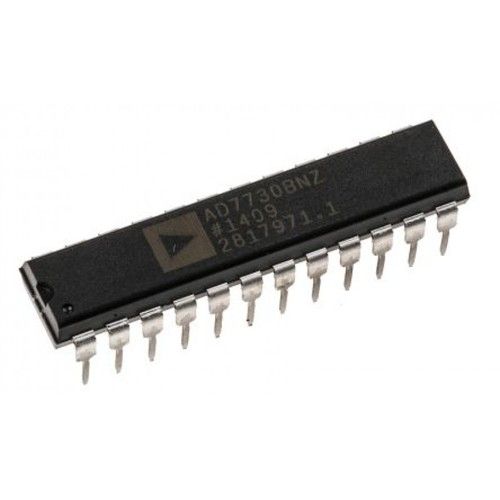
ISOLATION AMPLIFIER IC
200 INR/Piece
Product Details:
- Power Source External DC supply
- Features High common-mode rejection ratio, low noise, fast response
- Input Analog voltage signal
- Usage Signal isolation for sensitive analog circuits
- Power Supply Dual polarity (+/- 15V DC)
- Thermal Conductivity Low, plastic DIP/SOIC
- Resolution 12-bit (typical)
- Click to View more
X
ISOLATION AMPLIFIER IC Price And Quantity
- 200 INR/Piece
- 20 Piece
- 2500 VAC
- SOIC-8 / DIP-8
- 0.05%
- 2500 VRMS
- 0.5%
- <100
- -55C to +125C
- 50 kHz
- >100 M
- Yes
- 10 mA
- Yes
- Through-hole / Surface mount
ISOLATION AMPLIFIER IC Product Specifications
- 11 mm x 9 mm x 2 mm
- Signal isolation for sensitive analog circuits
- Isolation Amplifier IC
- 2 mm (chip package)
- Black
- Isolation and signal amplification
- Analog voltage signal
- High common-mode rejection ratio, low noise, fast response
- Industrial automation, medical devices, test and measurement equipment
- 250 VAC
- Typical 6 mA/quiescent
- +/- 15V DC
- External DC supply
- Monolithic analog IC
- Isolated analog voltage signal
- <2 s
- -40C to +85C
- Pin-based (standard IC)
- 12-bit (typical)
- DC to 50 kHz
- SOIC/DIP-8 standard package
- Dual polarity (+/- 15V DC)
- Low, plastic DIP/SOIC
- Approx. 5g
- 2500 VAC
- SOIC-8 / DIP-8
- 0.05%
- 2500 VRMS
- 0.5%
- <100
- -55C to +125C
- 50 kHz
- >100 M
- Yes
- 10 mA
- Yes
- Through-hole / Surface mount
ISOLATION AMPLIFIER IC Trade Information
- Cash in Advance (CID)
- All India
Product Description
This ISOLATION AMPLIFIER IC is used to measure electrical signals while providing electrical isolation between the input and output circuits. It typically consists of a differential amplifier, a voltage reference, and an isolation barrier. The isolation barrier provides electrical isolation between the input and output circuits, preventing electrical noise and other disturbances from affecting the signal measurement. This ISOLATION AMPLIFIER IC is commonly used in medical equipment, industrial control systems, and other applications where accurate signal measurement is critical and electrical noise is a concern.
Maximize Signal Integrity with Superior Isolation
This isolation amplifier IC significantly reduces interference and noise, preserving the integrity of analog signals across industrial and medical systems. Its high common-mode rejection ratio and low noise profile protect sensitive equipment from voltage surges and ground loops, ensuring consistent data accuracy during operation.
Versatile Application Across Industries
The device supports a wide range of applications, including industrial automation, medical instrumentation, and testing equipment. Its flexible package types and dual mounting options allow easy integration into existing hardware, while RoHS compliance and lead-free construction align with modern environmental standards.
FAQs of ISOLATION AMPLIFIER IC:
Q: How is the isolation amplifier IC mounted in a circuit?
A: This IC can be mounted using either through-hole or surface mount technology, compatible with standard SOIC-8 or DIP-8 packages, ensuring flexibility for varied PCB designs.Q: What is the main benefit of using an isolation amplifier IC in medical devices?
A: By providing 2500 VRMS isolation and excellent linearity, the IC prevents potential electrical interference, safeguarding patient safety and maintaining precise signal readings crucial for medical diagnostic equipment.Q: When should an isolation amplifier be employed in test and measurement equipment?
A: Deploy an isolation amplifier when precise measurement of low-level analog signals is required in environments where electrical isolation is necessary for safety and signal fidelity, especially when measuring across different ground potentials.Q: Where is the IC typically used within industrial automation systems?
A: It is commonly integrated into signal processing modules, sensor interfaces, and monitoring circuits where separation between control and measurement sections is essential to avoid ground loops and electrical noise.Q: What process is followed to configure the supply voltage for this IC?
A: The IC is powered using an external dual polarity DC supply, typically +/-15V DC, which should be connected to its designated power pins according to the provided application circuit or datasheet.Q: How does the isolation amplifier improve signal accuracy?
A: With a gain accuracy of 0.5% and a linearity of 0.05%, alongside high input impedance, the amplifier minimizes distortion and error, resulting in consistently precise signal amplification and transmission.Tell us about your requirement

Price:
Quantity
Select Unit
- 50
- 100
- 200
- 250
- 500
- 1000+
Additional detail
Mobile number
Email

Other Products in 'Electronic Components' category


Contact Details
KK INTERNATIONAL
Mumbai, Maharashtra, India
Mumbai, Maharashtra, India

- Plot No. 305, Rajdeep Apartments, Tara Temple Lane, Near Lamington Road,Mumbai - 400007, Maharashtra, India
- Phone : 08045477473
- Mr Pratik Chouhan (Managing Director)
- Mobile : 08045477473
-
 Send Inquiry
 Send Inquiry
 Send Inquiry
 Send SMS
Quick Inquiry

 |
KK INTERNATIONAL
All Rights Reserved.(Terms of Use) Developed and Managed by Infocom Network Private Limited. |
